This morning Mark Batterson posted about how after leading the Ethiopian Eunuch to Christ, Philip “teleported” to Azotus (actually the text says “the eunuch did not see him again … Philip, however, appeared at Azotus …”). Mark compared this to his ability to “teleport” all over the world via podcast. Those of us who are church IT nerds and not pastors really need people like Mark Batterson to put what we do in theological terms. Thanks, Mark. Hopefully I’ll remember this the next time someone asks me about church podcasting.
Author: Clif Guy
Tony Morgan asks a great question
Check out Tony Morgan’s post today “Lifting people up or loading people down?” Tony, it’s not only volunteers we need to be concerned about. Sometimes it’s staff.
This issue of work/rest balance in life is resonating with me, particularly in light of the talks by Andy Stanley and Wayne Cordeiro (thanks Tony for the synopsis) at the Willow Creek Leadership Summit. I attended the Summit with my whole team, several of whom said Andy and Wayne were talking to me. I needed to slow down, they said. So the next week I took a day off and moved my daughter into her dorm for her freshman year at Park University. That was important, but I have some more resting to do.
It’s been a difficult summer:
- We lost a staff person in IT – the 3rd one we’ve lost this year (and it really hurt)
- We had the usual vacations
- I had the most unfortunate experience of passing a kidney stone
- We hosted the Willow Creek conference
- We’ve had emergency outages in our phone service and our database server (which hosts Shelby and Track It)
- We’ve had a number of major infrastructure projects going on including new firewall, new web content filtration system, new anti-virus software, new phone company, new online bookstore, new online box office, updated web site navigation, and the biggest of all, our new location – Resurrection West
- And all of this is on top of our routine workload of tech support, computer upgrades, new staff coming in, and on and on
We simply haven’t been able to keep up.
So Tony, I’m with you. As one of the burdened, I’m wondering if sometimes we’re adding to the burdens of our congregants, volunteers, and staff. If they’ve had a summer anything like mine, they’re ready for some rest. Yet others are ready to take the next step if only we will challenge them. We need wisdom to know when to push and when to relax.
Volunteering at Promise Keepers
This weekend I had the honor of serving as a volunteer Evangelism Supervisor for the Promise Keepers conference in Kansas City. Around 300 men responded to the altar call on Friday night, more than 100 of which were accepting Christ for the first time. I’ve done this before. It’s an amazing experience every time.
I was too busy with my duties Friday night to take pictures, but here are a few shots of serving lunch to approximately 7,000 men on Saturday.

Promise Keepers has been serving lunch at the conference for years. They have it down to a science. A refigerated semi-truck rolled in, a forklift unloaded pallets of boxes, volunteers stacked them just a certain way, and finally the volunteers opened the boxes.

Each box has eleven lunches. They’re all the same so people won’t take time looking for their preference.
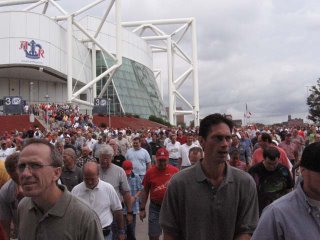
And here they come! (By the way, I saw Jim Walton in this line. I hope you had a great experience, Jim.)
Leadership Summit
This is the first time we’ve hosted the Willow Creek Leadership Summit at Church of the Resurrection. Ian helped me setup a laptop to connect to the Windows Media video stream for use as a backup to the main video feed that comes in over satellite. Turns out, we needed it in the very first session on Thursday morning due to storms in both Chicago and Kansas City. Good thing it worked!
Here’s the rigged-up rear-screen projector:
This is the laptop showing the video stream full-screen:
Conference attendees in the sanctuary:
People in the Narthex:
My wife, Laura, and daughter, Beth:
A new Arena?
Blackbaud’s open API
In a post last week, Tony Dye quoted Blackbaud’s CTO regarding their open API. I hope other ChMS vendors are reading Tony’s blog and took note of that post.
I’m done with Pluck
I’m done with Pluck.
Last summer when I began blogging and reading blogs on a regular basis, I surveyed the available RSS readers and ended up liking and using Pluck. I liked Pluck because it integrates with IE and it allows me to mark posts as read so at any time I can come back and see easily the unread posts.
Unfortnately, Pluck has been neglected. It hasn’t been updated since last November and now certain bugs are really starting to bug me. Recently I realized that Pluck was missing new posts in some of my favorite blogs. It also frequently has errors reading feeds, which show up as messages I have to mark as read.
I tried Bloglines, which is cool, but it won’t import my OPML and I don’t have the patience to re-subscribe to all of my feeds in Bloglines.
I’m playing around with Vista beta 2 and Office 2007 beta 2. Vista comes with IE 7 with its built-in RSS reader. So that’s my new reader, at least for now. Goodbye Pluck, I’m sorry to leave but you let me down.
Podcasting sermons
Dan Bryant, a Disciple pastor in Eugene, Oregon, recently e-mailed a question about the Living Water site. Rather than answer him individually, I am posting the answer here. Dan writes:
I am exploring podcasting and found yours. Nicely done! Can you tell me a little about your experience with it, how much effort it takes, how useful it is, software you use, etc.?
Dan, start with my post explaining the simple technology behind how we publish the Living Water podcast on the web. Next, take a look at the post where I talk about the process of getting listed in the iTunes Music Store podcast directory.
Now, all of the above assumes you can create MP3 files of your sermons. At Living Water I do that by recording the service live off the house mixer, through a DBX 166 compressor, and then to a Tascam CD recorder. After the service, I use FreeRip to rip the sermon track to WAV. Then I use my 5 year-old copy of Cool Edit 2000 to trim it, adjust levels, and save it out as an MP3. Finally, I use MP3tag to fill in the metadata for the MP3 file. Yes, that is quite a few steps. None of the steps are particularly difficult, but it’s a lot of fiddling around.
Looking for a simpler way? Try Sermons Online. I haven’t used it, but my fellow Appian Way blogger, Chuck Russell, highly recommends it.
As to whether it is useful, we are excited that we have many people across the country and around the world downloading our sermon podcast. In fact, our weekly podcast downloads exceed our average worship attendance. A statistic like that will really make you take notice.
Thanks for the question, Brian. And happy podcasting!
Meeting Kasper in North Carolina
Brian and I are in Lake Junaluska, North Carolina (in the Smoky Mountains of western North Carolina) for a meeting of Web Empowered Church developers. Tonight I got to meet Kasper Skarhoj, the original brain behind TYPO3. I wished for a camera so I could show you Brian, Pania (Brian’s wife), me, Mark Stephenson, Kasper, Mark’s son, and Jeff Segars at dinner tonight. It was a historic moment.
Brian and I will have more to say about the conference over the next couple of days.
Open source Church Management System (ChMS)
Shelley Hildebrand of Perimeter Church recently posted to the Church Management System (ChMS) Google group to ask whether there is interest among churches in building an open source church management system. Then she e-mailed me and asked if I would post a reply. This is a huge question that I have been pondering for most of three years. I can’t possibly give a full explanation of our current thinking in a single post, but here at least is a strategic summary.
>>First, many readers of this blog and the Google discussion group already know about Web Empowered Church (WEC), but for those who don’t …
WEC is an initiative of the Methodist Foundation for Evangelism. The director of WEC is Mark Stephenson, Director of Cyber Ministry for Ginghamsburg Church, a large and well-known Methodist church outside Dayton, Ohio. WEC is building church-specific web applications on top of an enterprise-class, open source content management system called TYPO3.
TYPO3 is very powerful and so not surprisingly it’s quite complex as well. Consequently it has a fairly steep learning curve, even for experienced web developers. To help new churches get over this complexity barrier, WEC provides a pre-configured TYPO3 package called the “WEC Starter Package,” with all of the WEC-built ministry extensions pre-loaded. WEC has some pre-built TYPO3 templates to accelerate site design for smaller churches that don’t want to do a custom design. Also, WEC has established a web hosting firm in the greater Philadelphia area called Vine Hosting. Their equipment is located in a world-class data center in Newark, New Jersey. Through the Starter Package, the pre-built templates, and the hosting, WEC is working diligently over time to ease the difficulty of building and running a church web site in TYPO3.
WEC has been operating less than two years and has already gotten some serious worldwide traction. See the cool Google mashup map of churches around the world using WEC and a list of example sites.
I am the IT Director at Church of the Resurrection in Leawood, Kansas (Kansas City area). We were the first church to catch Mark’s vision for WEC and become part of it. We rebuilt our sites in TYPO3 starting in July 2004 and went live five months later. Earlier this year, we forged an even deeper connection with WEC when our most senior IT guy, Brian Slezak, transitioned into a new role as a software developer with WEC. He is still on our staff and still has a desk in our department, but he now works full-time on building ministry extensions for WEC.
Bottom line: WEC has all the earmarks of a God thing. It’s a God-sized dream being lived out in a Kingdom-like way. It’s amazing what God has already done and very exciting to see what God will continue to do in the future through WEC.
>>Okay, so what does all of this have to do with the question of an open source church management system? I realize that open source isn’t for everyone. At Resurrection we are a Microsoft shop everywhere except our web sites. I’m not a Microsoft basher at all. We use a lot of their stuff and are particularly appreciative of their steep non-profit discounts. Also, I can see a place for commercial providers of church management systems such as Shelby, ACS, and Fellowship Tech. I know some people with these companies are readers of this blog and our Google discussion group. I don’t speak for Resurrection, but I know that the church values its suppliers and seeks to bless those who provide us with everything we need to do ministry.
Having said that, I do believe that God is honored and the Kingdom is advanced when churches across geographical and denominational boundaries come together in the common cause of disciple making. We have differing styles, mission fields, and theological points of view, but we have one Lord and we proclaim one gospel. We’re all on the same team. Take a good look at that WEC map and you’ll see an amazing example of how this vision of cooperation is actually working in the world right now. Thinking strategically about this, I conclude that the open source model of software development and distribution is ideally suited to fostering technological cooperation among churches around the world. Let me quickly add that I acknowledge the technical challenges of open source, including the lack of support for “normal people” mentioned by Jeff Berg. Despite that, the benefits of open source in this situation are truly compelling. If Perimeter Church builds something on a common platform that Church of the Resurrection can pick up and use, I think we really have something special going on that glorifies God and represents awesome stewardship.
So, answering Shelley’s question directly: Yes, I think open source makes total sense for the church. And yes, we are interested in working with other churches to develop an open source church management system. WEC is also very interested in this and hopes to be a catalyst and focal point for making this happen. The blogosphere is a great way to circulate this idea, gather support, and find like minded churches to get involved. I’m trying to listen to God to hear if He really is behind this. If so, within the next six months I hope to see a consensus emerge around a group of churches that will contribute resources and technology to a WEC-sponsored effort to build a ChMS on the open source/TYPO3 platform.
Is anyone else out there as excited as I am about this?
 Clif Guy sporadically