Lunch with Jim Edwards

Brian, Travis, and I had lunch with Jim Edwards today.  We wanted to heard about his experiences with Arena over the last year.  He was a very early adopter of Arena at Kansas City Baptist Temple.  Their implementation strategy was quite different from ours.  They continued to run Shelby V5 for months as they systematically converted ministry teams to Arena one-by-one.  This is possible with Arena by taking advantage of the available two-way database triggers that keep Arena in sync with V5 and vice-versa.  By contrast, we’re planning a more traditional "big bang" cut over where we will be running on V5 one day and Arena the next.  It was very interesting to learn how Jim made his approach work.  I’m sure there are lessons in there for us and other churches implementing Arena.

Jim filled us in on a few specific Arena "gotchas" that we need to manage.  That alone made the lunch worthwhile.  Jim was also quite complimentary of the Arena tech support team.  Very good to hear.

Finally, Jim told us about a new strategy they have to improve the quality of new hires at KCBT.  I encouraged him to blog it.  I’ll link to his post when he does.

Thanks, Jim for a very helpful conversation today.  We’re already rethinking some important things.

MinistryTECH and RoundTable

If you’re like me, you’re planning to go to MinistryTECH and the Spring Church IT RoundTable in Oklahoma City the first week of April.  Again if you’re like me, you haven’t registered yet.  :-(  You probably have to figure out all of the travel and event costs, get the expenditure approved, make travel reservations, and actually register for the events.  Despite your best intentions to do all of that, you haven’t made time for it in your busy schedule.  You have a good reason.  I, on the other hand, have the incredibly capable assistance of Amy Facemire for such matters.  The only reason all of the above isn’t done is that I didn’t ask her to do it until a couple of days ago.  Doh!  (I just need Jason Lee to help Amy figure out Priceline!) 

So, whatever your situation or excuse might be, this is your reminder that you need to go here to register for MinistryTECH and here to register for the RoundTable.  See you in April!

Sad web site story

I recently received an e-mail from a pastor who resigned from his congregation.  The last straw for him was conflict over the design of the congregation’s web site.  (That’s right, a well established congregation in a major denomination is just now building its first site in 2008.) 

He wrote:

We had a large disagreement about the purpose of a web site. They wanted it for upkeep of our calendar and shut-in lists, etc. I wanted it to be an evangelism and educational tool- sermons, blogs, mp3 and video. When I tried to convince them that it could be all of the above they really didn’t want to hear it. It was a small example of the big picture problem I’ve had with them for 7 years.

The pastor was working with Vine Hosting to build a Web Empowered Church site using the WEC Starter Package and pre-built templates.  Presumably the project will be abandoned now that the pastor has left.

Even though I’ve lived in the dysfunctional, dying part of the US Protestant church for my entire life, this kind of thing still upsets and saddens me.  Congregations like this one seem determined to continue their overall decline, missional inattention, and kingdom irrelevance. 

I’m proud of the part we play in the work of Web Empowered Church.  WEC’s greatest obstacle is the all-to-common attitude displayed by this congregation.

Trying again on the Wireless LAN bridge

It’s been quite some time since I gave an update on our experience with the wireless LAN bridge that connects our staff offices at Southcreek (SC) with our Central Campus (CC), 1.7 miles away.  After putting the pair of 80 GHz radios from Bridgewave into service, I posted about how we were suffering from link outages due to rain fade.  This is a problem because the bridge is the only connection to our 40 staff at SC, carrying voice, LAN access to our data center, and Internet access.

The signal budget takes into account the clear-air RSL (received signal level), an allowance for rain fade according to weather models, and a small margin before link drop.  The link will definitely drop at -72 dBm, but link quality gets very poor with high Ethernet frame errors at around -69 dBm.

Here’s the timeline:

Apr. 10, 2007: Link is live just before staff move-in.  RSL is -45 dBm on both ends, giving a fade margin of 24 dBm.  Link down for 1 minute in a brief, heavy rain.

Apr. 16, 2007: Based on some rain events during the test period, we decide to move the CC radio to a more favorable location.  We also replace both radios after observing link drop at -66 dBm, which was 3 dB higher than the specification. RSL is -41 dBm CC and -44 dBm SC.  For the first time we notice a significant difference in RSL on the two ends.

Apr. 25, 2007: Afternoon storms result in 23 minutes of outages.  Staff at SC are inconvenienced, but understanding.

May 6, 2007: A large storm brings flooding rains to much of Kansas.  Link is down for a total of 76 minutes.  It’s a Sunday when staff are not in the office, so no impact.

May-July 2007:  Link drops every time there is a decent rain.  Some of these are during office hours, causing user impact.  Staff at SC are getting restless.  We continue to document each incident, providing our vendor RSL data captured by What’s Up Gold and rain gauge data from the official city gauge near SC.

Aug. 2007:  We continue to experience outages during relatively routine rains.  Our vendor begins to discuss the possibility of putting high-gain (2′ dish) antennas on one or both ends of the link.  They cost around $2,000 a piece and are designed to increase signal strength by approximately 6 dB each.  We press our vendor to help us with this since the link isn’t meeting our availability requirement.

Sept. 20, 2007:  SC end RSL drops from -44 dBm to -54 dBm.  What’s Up Gold records the drop, but the link stays up so we don’t notice.

Nov. 20, 2007:  Issues are resolved with the vendor.  Bridgewave provides the high-gain antenna at cost.  Our vendor installs it on CC end.  When looking at RSL values post installation, we discover the 10 dB drop that happened two months earlier.  RSL increases from -42 to -36 dBm CC, and from -54 to -48 dBm SC.  Winters in Kansas City are relatively dry, so outages are rare and we still have plenty of time to resolve the issues.

Feb. 15, 2008:  After further discussion with Bridgewave, they agree something is wrong with our SC radio and ship us a replacement along with a high-gain antenna.  RSL increases from -36 to -31 dBm CC, and from -48 to -32 dBm SC.  So the SC end got the 10 dB back, plus the additional 6 dB from the high-gain antenna.  Photos of the installation are below.  You can see how much larger the high-gain antenna is.
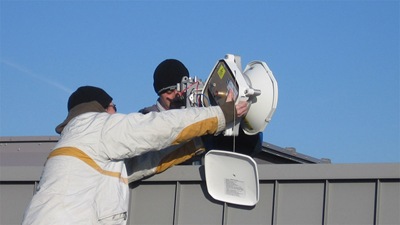
Old Bridgewave radio being uninstalled

Old radio being uninstalled

New Bridgewave radio with 2' antenna being installed

New radio with 2′, high-gain antenna being installed

Clear air signal strength of -32 dBm means we now have 37 dB of fade margin.  With that much margin, we estimate that the link will stay up during rain rates up to around 1.5 inch/hour.  According to the weather data model used by our vendor, that should give 4 nines of availability in an average Kansas City year (56 min. total down time).  Of course, no year is actually average, so we’ll just have to wait and see what happens.

Over the weekend we had a storm that started as moderate to heavy rain and ended as warm, wet snow.  During the heaviest period of rain, the signal dropped briefly to as low as -59 dBm.  That’s encouraging because we still had more than 10 dB of fade margin at that rain rate.  That event would have caused a link drop if it happened before the high-gain antennas were installed.  Big improvement.

When it started snowing yesterday, the signal dropped steadily from -37 to -67 dBm over a period of five hours.  Turns out the wind direction was directly into the the CC radio’s face, causing the wet snow to accumulate on the antenna.  When Ian got up on the roof and cleared the snow, the signal immediately came back up to -37 dBm.  Yeah – a 30 dB signal drop from snow on the antenna.  Yikes!  Ian has full details, including pictures, on his blog.

Should you ever cancel church due to weather?

We never have before and probably never will again at Living Water, but today was the exception that proves the rule.

The storm began around 6:00 am.  The snow came down in huge, wet flakes and accumulated rapidly.  By 9:00 am the roads were a mess.  My mom couldn’t get up the hill out of her subdivision.  Regardless, we NEVER cancel church. 

Upon arriving at church, we discovered that the company we have contracted to plow our parking lot hadn’t been there.  All that white stuff on this side of the sign?  That’s snow where our driveway should be.

IMG_1672-web

The driveway is steep and narrow.  Even with our front-wheel drive van with traction control I couldn’t get up the driveway into the parking lot.  This was only an hour before the service was to begin.  So, we really had no choice but to cancel.

With a second effort of aggressive winter driving learned as a youth in Des Moines, I did finally get up the driveway.  Laura posted a notice on our web site and started calling as many people as we could to let them know.  Laura was still planning to preach to the empty room for the sermon podcast.  While we were getting ready, I snapped this picture of the still raging storm out the back window of the church.

IMG_1668-web

And then two cars made it up the driveway and stopped in the parking lot.  The first car was one of our families coming for worship.  It was one of the girls’ birthday and she invited her grandparents, who arrived in the second car.  Cool!  So we canceled, but still had the service with Laura, me, and two carloads of people who didn’t know we canceled.  So I guess we really will never cancel church.  Even if it’s canceled, we still have it!

If you’re curious, read Laura’s recap of the service and check out the podcast here.

Identity and interoperable social networking

Social networking and social media have been near the top of my mind since our senior pastor first announced our Internet campus initiative.  I see social networking as the primary method of reaching our target audience – tech-savvy people who "live" online.  The Internet campus will grow as participants share church-generated content with friends through social networking technologies and as participants create their own content in response.

Since I first began posting on this topic, I have repeatedly mentioned the issue of online identity because I think the lack of an open, portable identity system is already putting a drag on the adoption rate of social networking and social media sites.  There are simply too many sites, too many accounts, and too much maintenance required.  User fatigue is setting in.

Recently, there have been a number of encouraging technological developments.  This week came the announcement that Google, IBM, Microsoft, VeriSign and Yahoo! have joined the OpenID Foundation.  OpenID is gathering steam.  This is most welcome.

The second major technological issue is the lack of an open, portable way to exchange social graph data.  (Of course, identity data and social graph data are closely related.)  OpenSocial got some buzz when it was first announced in November.  Unfortunately, our hope was short lived when we realized that Facebook wouldn’t allow us to access its data and pull that data into applications outside of Facebook.

This week Brad Fitzpatrick of Google announced the Google Social Graph API.  As part of its normal search indexing, Google is now crawling the Web for XFN and FOAF markup and provides whatever it has found to calling applications via their API.  Matt Bradshaw of our team and Web Empowered Church has already built a simple application using the API.  As soon as he has a web UI for it, I’ll post it here so you can play around with it.  I can’t overstate how cool this stuff is.  When you see it in action, you’ll immediately grok the significance.  This is a major step along the path of interoperability and portability.

Kansas Republican caucus

This morning I participated in the Kansas Republican presidential caucus.  This is the first time in my 22 years of living here that Kansas has had a presidential primary or caucus.  Even though John McCain already has an insurmountable lead in delegates, my fellow Republicans turned out in large numbers to vote for their preferred nominee.  My caucus site was prepared for 250 people.  It appeared to me that more than 1,000 came out. 

People began lining up outside the community center on this chilly morning more than an hour before the caucus started.

Waiting for the caucus

The cool thing about a caucus is that "electioneering" (openly displaying support for a candidate near or within the polling place) is not only permitted, it is actually encouraged.  In line I saw a young Huckabee supporter with a hand-made sign.

Young Huckabee supporter

She was still holding up her sign when we got into the meeting room.

In the caucus

Ron Paul supporters also made themselves known.

Signs-in-the-caucus-web

Because the room would hold only 250, the caucus chairperson decided to allow people to cast their ballots and not stay for the meeting.  That was the right decision.  As you might imagine, there was a lot of talk about making sure the Kansas legislature approves a primary in 2012.  I’m pretty sure Republicans and Democrats will agree on that next time!

If you’re curious, I voted for Huckabee although I harbor no illusions that he will be the nominee or that he would be electable this cycle if he did win the nomination.

Jon has already helped

We’re now in the middle of our Arena implementation.  A couple of days ago we became concerned about certain aspects of our Arena performance.  The thought occurred to me to contact Jon Edmiston to ask about his experience of Arena performance since he has a very large Arena installation.  We found the main number for CCV, called, and asked for Jon.  In a few moments his friendly voice answered – no appointment, no warning.  In fact, Jon and I have never met except through reading blogs.  And yet there he was on the phone. 

In 15 minutes he answered our concerns.  Turns out if you have a large number of tags (we do) certain infrequently accessed pages can take a long time to display.  We need to take care to prevent unnecessary tags from proliferating.

As we hung up he offered to help any time.  Thanks, Jon for being so accessible to us.  I hope we can return the favor sometime.

Seems inevitable that Asterisk is in our future

It started with success stories from Andrew Mitry and Justin Moore.  Now comes the announcement from Jon Edmiston that CCV has cut over to Asterisk.  This morning I read an article in Network World about Asterisk.  You know when Network World starts talking about it that it has emerged into the mainstream.  So now I must concede that Asterisk will be in our future.  Most likely the first opportunity to deploy it will be in our new downtown campus now in the planning stages.  Asterisk has simply become too cool to ignore.  Thanks Andrew, Justin, and Jon for paving the way.  We’ll be calling on you for advice when the time comes.